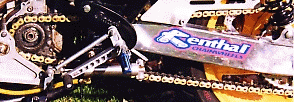
Chain and Sprocket Tips
Chain care is one of the most important
maintenance tasks you can perform for your bike. If you do not care for your
chain and sprockets ,
YOU WILL NOT MOVE.
You did not buy the bike to sit still, so let's talk chain care.
1- Inspect your chain for problems EVERY time you get ready to ride.
If your chain breaks while you are moving it can not only be embarrassing, it
can cause catastrophic damage to the bike or YOU!
Any of the following can cause failure;
A- Broken
rollers (these are the round parts that ride against the teeth
of the sprockets). Look for rollers that look broken or are a different size
than the others.
B- Out-of-place link pins (these
are the rivets holding the links together) If any of the pins look like they
have shifted into or out of the plates, they are out-of-place. If one of these
pins moves too far the chain will fail.
C- Rusty links Rust can be caused
by many things; lack of lubrication, battery acid, heat, and age. Rusty links
can hide cracks and should be treated as a problem.
D- kinks (this is where the chain
goes in a zigzag instead of a nice strait line from the motor to the rear
sprocket)
E- Broken or bent sprocket teeth
the teeth on the sprockets need to be perfectly strait. If they are bent the
chain may not track true and could fail.
F- Loose chain the
chain should have no more, or less, than approximately 1 inch of movement up or
down if you grab it half way between the two sprockets. (Don't
forget to adjust BOTH sides of the axel adjusters so they are EVEN. The rear
wheel MUST track strait)
Also, if you move the bike backwards and
the chain "pops" , you definitely have excessive chain and sprocket
wear. This is true because a bike travels forward all the time so the sprockets
tend to wear in a directional pattern. This will cause the chain to bunch when
turned in the opposite direction.
You have probably heard the term "chain stretch". This is the term
used for the amount of wear the holes, that the link pins run through. The
wear makes the hole "egg shaped" , and this causes the chain to seem
stretched. Look at it this way, if every pin on your chain has 1/64th of an inch
wear a 110 link chain is 1.72 inches longer than it
was new. Most rear sprockets average about 40 teeth and approximately half , of
the teeth, have the chain riding in them. Using the 1/64th wear ratio that's .31
inches (just over 1/4th of an inch. This wear does not allow the chain to sit
between the teeth of the sprocket causing the chain to ride up each following
tooth slightly more than the previous. This problem also makes the chain shift
on the sprocket anytime you down shift and then accelerate. All of this also
causes excessive sprocket wear and noise.
LUBRICATION
To properly lubricate your chain you must first clean the old oil and grit off.
Be careful to use a proper solution to clean it. Some chains can be damaged by
petroleum cleaners (like o-ring chains). If you do not clean the chain the dirt
and sludge will allow the new lube to fly off and the grit to cause wear. They
do make some good kits for doing this. We sell a great solution for cleaning the
chain called "Sludge Away" that will not harm o-ring chains found in
the Liquids section of the catalog. A small brush, chain cleaner, and a
couple of shop rags will work too. If you have a non o-ring chain you must not
do too much cleaning or you will dry out the internal part of the chain. You
have to dip the chain in hot liquid grease (not a fun job) to fix this. That's
the idea of an o-ring chain. It keeps the grease inside the chain where you can
not easily get to.
If you do need to replace the chain make sure you think
about the following;
1- O-ring or standard chain? (O-ring does not require as much maintenance, but
is more costly than the standard type chain.)
2- Tensile Strength of chain in comparison to the size and power of bike? (This
is the average maximum pounds the chain can handle all at once)
3- Replace sprockets too? (to get maximum smoothness and mileage replace the
sprockets.
4- Peen-on link or clip-on link (If you do not have the very costly peen on link
tool, you need to ask if your new chain comes with a clip on link. If it does
not then you will want to buy one.)
Also, one of the main reasons chains break at the master link is lack of lube on
the pins of the link when it is installed. So GREASE IT!
There are probably other issues on chains and sprockets we did not cover. If you would like to see anything else listed, let us know.